Blog
Go backReply-All Apocalypse: How One Button Nuked the Office Inbox
Deep Dives · May 13th, 2026
Every office has a forbidden button. It sits next to Reply, looks harmless and waits patiently for someone named Kevin, Karen or the entire procurement department to make a mistake before lunch.
That button is Reply All, and it has caused more accidental workplace drama than broken coffee machines, mystery fridge smells and "quick sync?" calendar invites combined.
One click can turn a boring distribution list into a digital mosh pit. First comes the original message. Then the confused reply. Then the "please remove me" replies. Then the "stop replying all" replies, which are, magnificently, also replies to all. The system does not explode because email is weak. It explodes because humans are.
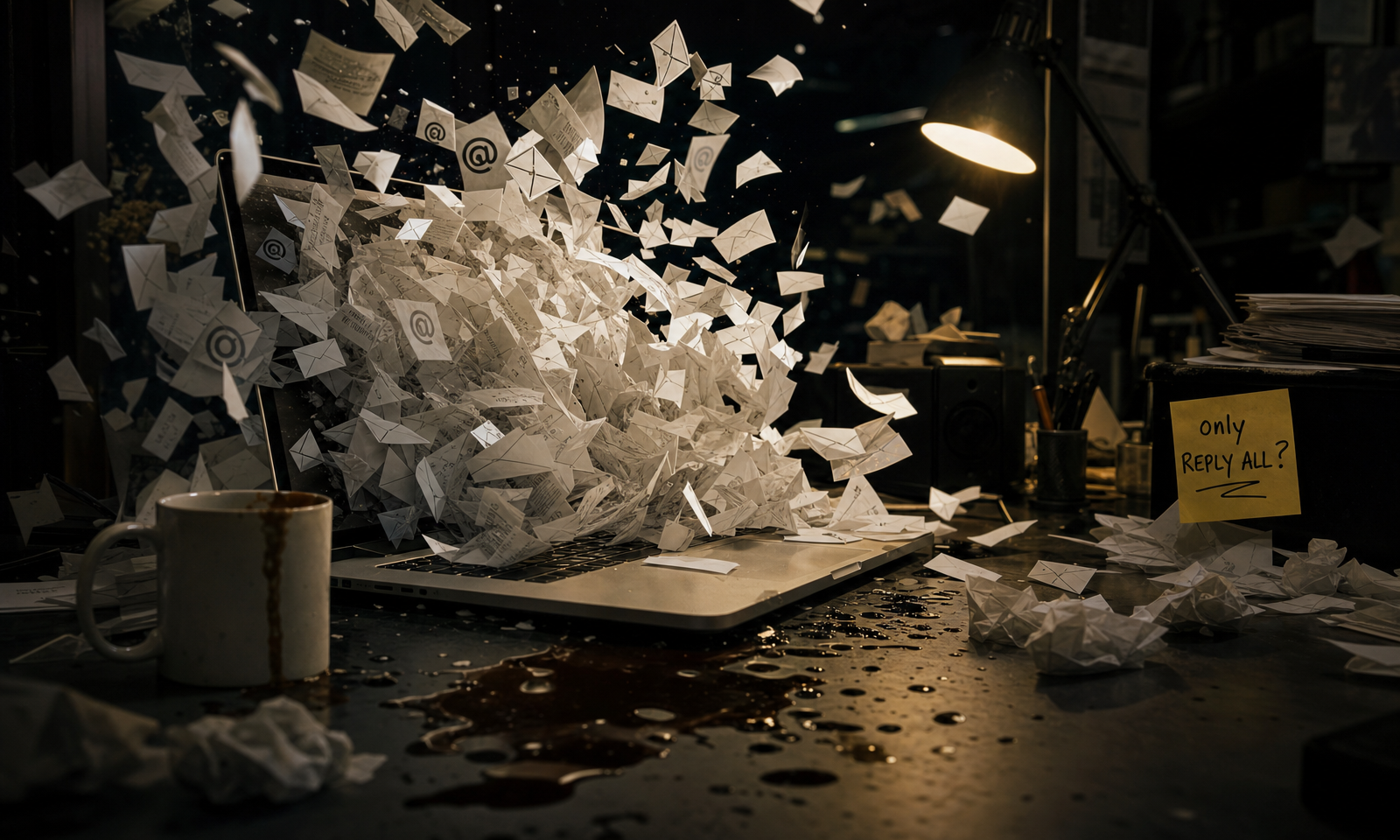 One accidental reply-all can turn a normal inbox into a company-wide weather event.
The Original Inbox Dumpster Fire: Microsoft Bedlam
The classic reply-all disaster happened inside Microsoft in 1997, which is funny in the same way a fire alarm factory catching fire is funny.
A Microsoft employee discovered they were on a mysterious distribution list called Bedlam DL3 and sent a message asking to be removed. Reasonable. Unfortunately, the list reached somewhere around 13,000 to 25,000 people, depending on the account. Then people started replying all with "me too," "remove me," and, of course, "everyone stop replying all."
The storm reportedly generated about 15 million emails in roughly an hour and around 195 GB of traffic. In 1997 terms, that is not "a little noisy." That is a beige server rack sweating through its Dockers.
Why Reply-All Storms Go Nuclear
A reply-all storm is not just a lot of messages. It is a feedback loop with office politics attached.
Big distribution lists multiply mistakes. Read receipts and delivery receipts can add extra shrapnel. Message recalls create more messages, because Outlook's idea of cleaning up the spill is sometimes to spill louder. Then social panic kicks in: people reply to complain about the replies, which becomes the exact thing they are complaining about.
It is the inbox version of everyone in a theater yelling "quiet" at the same time.
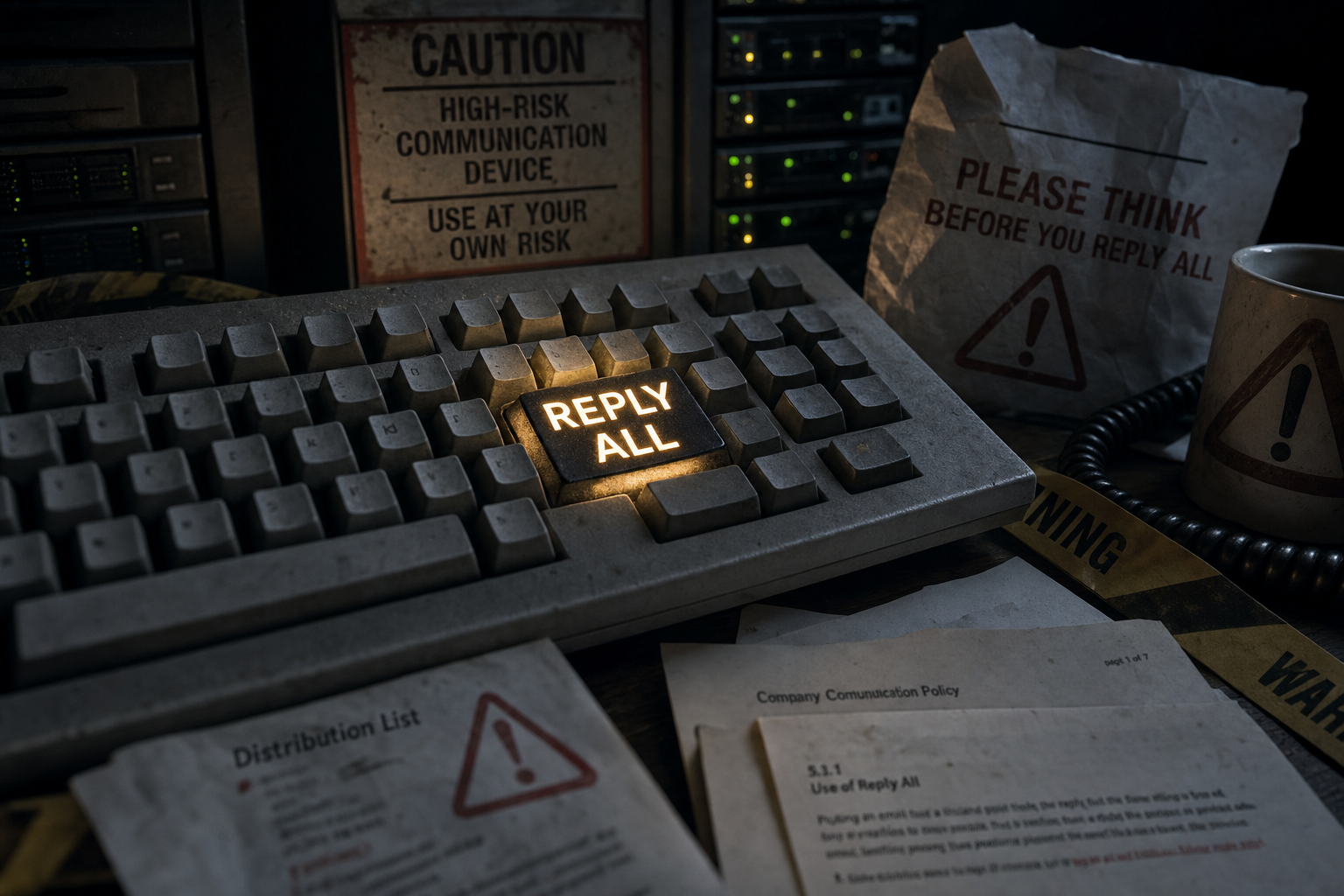 The dangerous part is not the button. It is the confidence people have before pressing it.
The NHS Reply-Allgate: 500 Million Tiny Screams
Microsoft was not alone. In 2016, the NHS in England got hit by a monster storm after a test email accidentally reached roughly 840,000 staff. The sender reportedly meant to reach fewer than 20 people, but a misconfigured dynamic distribution list had other plans.
Thousands replied all. Within about 75 minutes, the system generated around 500 million emails - roughly three months of normal NHSmail traffic jammed into one Monday-morning inbox blender. Some users saw delays for hours; others had mailbox trouble for days.
The funniest part, if you enjoy pain, is that the fix was exactly what should have existed before the incident: disable reply-all on the giant list, delete the broken distribution list and add actual guardrails.
Campuses, Governments and Other Places Humans Touch Email
Universities have their own reply-all folklore. In 2012, an NYU mailing list mistake let replies reach nearly 40,000 students. One student tried to forward a message to his mom and instead triggered what the internet lovingly called Replyallcalypse. The chaos included jokes, memes, existential questions and, naturally, a party invitation. If you give 40,000 students a shared microphone, you do not get silence. You get sociology.
Government has not escaped either. The US State Department suffered a reply-all storm in 2009 after a blank spam-like message reached a huge diplomatic list. Replies, removal requests and recall attempts piled up until the mess reportedly disrupted mail for days. The global diplomatic corps was briefly united by one sacred question: who the hell keeps hitting reply all?
Reply-All Survival Rules
- If the list is huge, do not reply all. Your joke is not good enough. Nobody's is.
- If you want off a list, contact the owner. Screaming at 20,000 people is not a ticket system.
- If someone starts a storm, do not tell everyone to stop. That is storm fuel wearing a safety vest.
- If you manage lists, lock them down. Moderation, sender restrictions and sane defaults beat apologies.
- If you are angry, wait 30 seconds. Most historic email disasters could have used one calm breath.
The Real Villain Is Bad Defaults
It is easy to blame the person who clicks. Sometimes they deserve it. But the bigger failure is usually design.
A company-wide distribution list should not behave like a dinner table where anyone can grab the megaphone. Massive lists need restricted senders, moderation, rate limits and clear ownership. Recipients should know when a reply goes to one person versus everyone with a badge and a pulse. The client should make the dangerous action obvious, not hide the blast radius behind a familiar button.
Email is old, but it is not dumb. We made it dumb by letting giant lists act like group chats from hell.
Why This Still Matters
Reply-all storms are funny until they delay incident response, bury urgent patient care updates, drown legal notices or train people to ignore internal mail. Noise is not harmless when the inbox is still where work gets confirmed, approved, documented and escalated.
The lesson is not "email bad." The lesson is email is infrastructure, and infrastructure needs guardrails. Roads have lane markings. Elevators have weight limits. Company-wide mailing lists need more protection than "surely nobody will be that stupid."
They will be. Eventually. On a Monday.
Where [@fuck.it] Lands
We love email because it is open, boring in the best way and still the universal protocol nobody managed to kill. But good email is not just servers and storage. It is friction in the right places.
The perfect inbox does not make every button equally dangerous. It gives users control without turning them into accidental broadcast towers. It respects attention. It blocks abuse. It makes the stupid thing harder and the sane thing easier.
So yes, use email. Trust email. Build on email. Just maybe look twice before you reply all to 40,000 people with "same."
Sources & further reading: Microsoft Exchange Team: Me Too! · Seattle Times on Bedlam · BBC on NHS Reply-Allgate · The Verge on NYU Replyallcalypse · related reads: The Day Email Didn't Die and Spam: From Canned Ham to Inbox Hell.