Blog
Go backWhat the #@$% Is a Grawlix?
Deep Dives ·
The string of symbols that stands in for a swear word in a comic strip, the #@$% coming out of a character's mouth, is called a grawlix. Mort Walker, the cartoonist behind Beetle Bailey, is generally credited with the word, from a 1964 article for the National Cartoonists Society titled "Let's Get Down to Grawlixes." The device itself is a good deal older than the word, and every time a researcher goes looking for the first one, they find an earlier one.
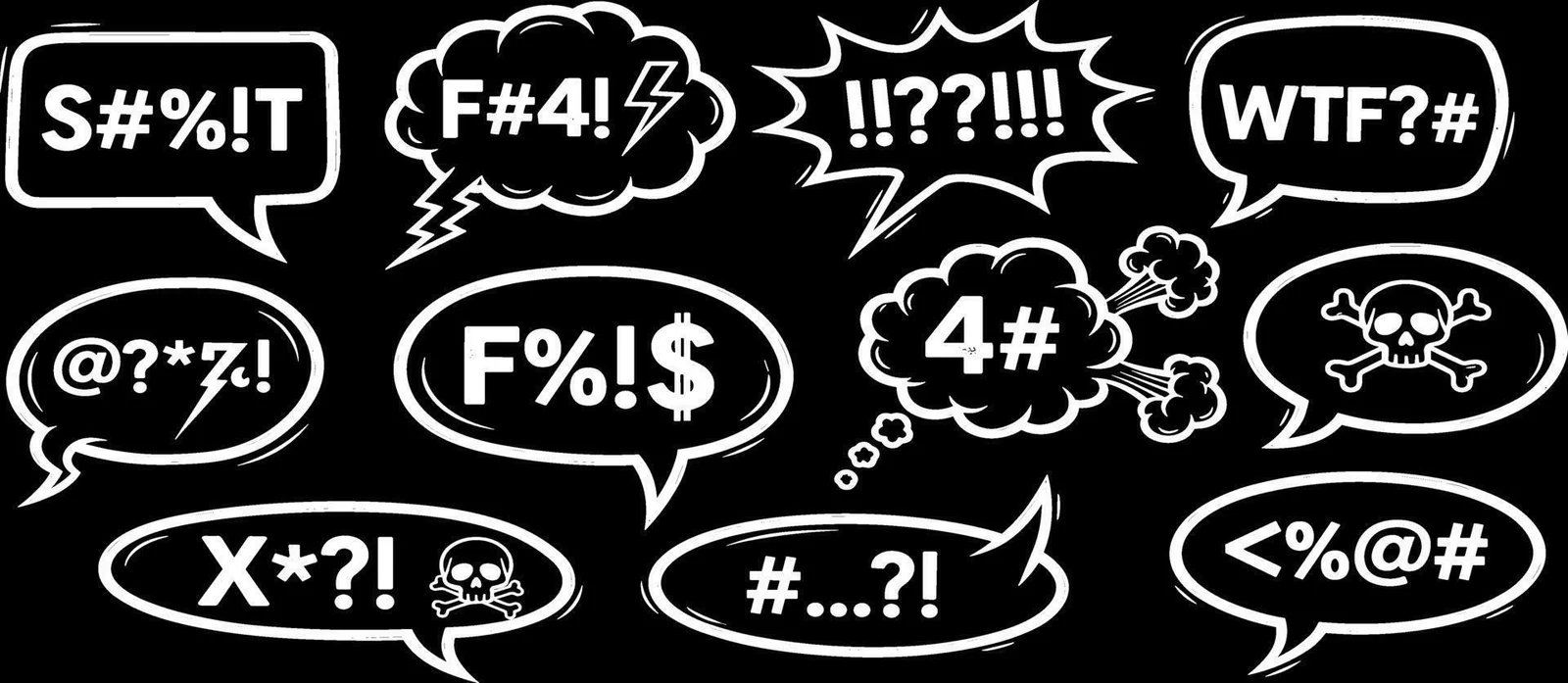 Once it reached the keyboard, the grawlix became a dialect. Skulls optional.
Nobody knows where Walker got the word. It sounds like a growl, and that may be the whole explanation.
TL;DR
- A grawlix is the #@$% that replaces a swear word in print. The name is Mort Walker's, from 1964.
- The earliest known example is from 1877, in a book of telegraph-office humor. Newspaper comics picked it up around 1901.
- Print had been hiding swear words behind dashes and asterisks since the 1700s. The grawlix just made the hiding fun to look at.
- Walker's 1980 Lexicon of Comicana was written as a joke. He later found it shelved under art instruction.
- Today it lives on keyboards and in the 🤬 emoji, which arrived in 2017. Asterisks and profanity filters belong to the same wider history of hiding words.
1751: The Dash
Printers were bleeping words long before anyone had a bleep. In Tobias Smollett's The Adventures of Peregrine Pickle, published in 1751, curses appear with dashes where their letters should be. The reader was trusted to fill in everything between the d and the n without help, and did. The dash became common through the eighteenth and nineteenth centuries, to the point that newspapers printed a single letter followed by a dash as if it were a word. The asterisk was doing the same job in the same period, standing in for a letter or two and trusting you to supply the rest.
Both had one weakness. They were dull. They removed the swear word and gave nothing back.
1877: Telegraph Operators Lose Their Temper
The earliest known fix is in a book called Lightning Flashes and Electric Dashes, published in New York in 1877: a collection of stories, poems and cartoons for and about telegraph operators. It includes a cartoon by James J. Calahan called Ye Telephonists of 1877, in which a noisy telephone operator upsets a room full of telegraphers, who respond with a string of symbols instead of words. The comics historian Thierry Smolderen documented it in his book The Origins of Comics, and for now it's the oldest example anyone has turned up.
Newspaper comics arrived at the idea a couple of decades later. On Friday, 1 November 1901, Gene Carr's strip Lady Bountiful ran in the San Francisco Examiner with a character cursing in symbols. The strip was about a wealthy, well-mannered woman who took in poor children, so the swearing was presumably theirs. A few weeks earlier, on 19 October, the same strip had printed a single starburst followed by an exclamation mark, an early hint of the idea in Carr's strip.
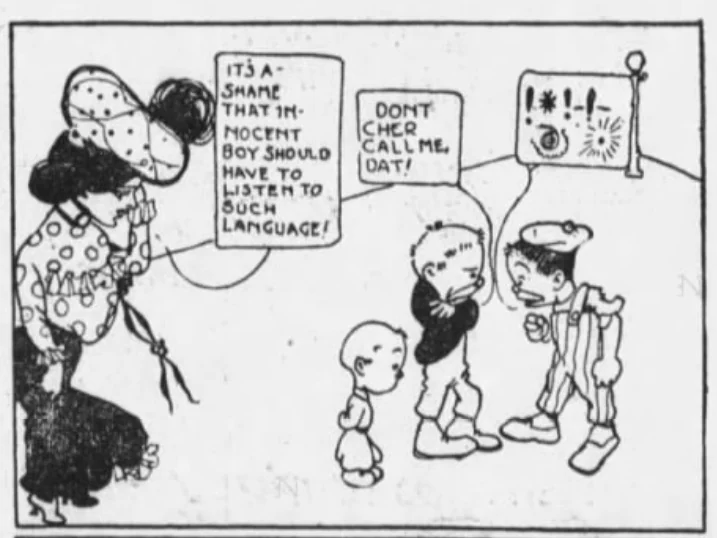 Gene Carr, Lady Bountiful, 1901. The innocent boy looks fine.
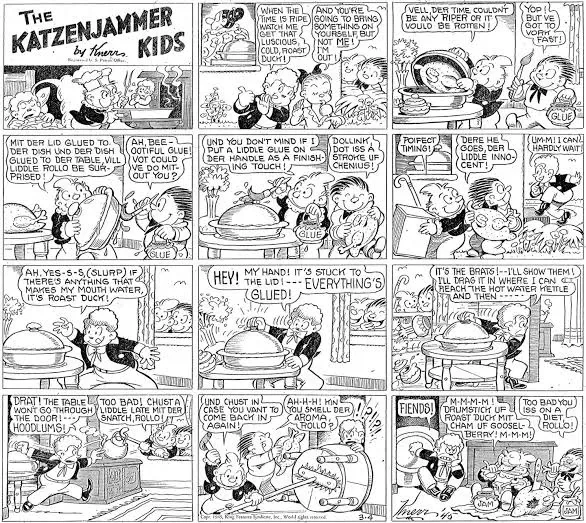 The Katzenjammer Kids, in the Harold Knerr years.
The example most people cite is later still. On 14 December 1902, in Rudolph Dirks's The Katzenjammer Kids, Uncle Heinie falls over and curses with a star, an anchor, two exclamation marks, a question mark and a blob. Dirks was long assumed to be the originator, because Dirks invented half of what a comic strip is. The linguist Ben Zimmer traced the device to him in 2010. Phil Edwards at Vox found the earlier Carr strip in 2019 by going through newspaper archives one page at a time. Smolderen, meanwhile, had already published the 1877 cartoon, and it took a while for the two conversations to meet. Dirks had been drawing the Katzenjammers since 1897, so there may be more to find.
The device spread quickly through the comics of the period, which competed to invent conventions. This one solved the dash's problem. The symbols hide the word and announce it at the same time. You can't read them, yet you know what kind of thing was said. The exact word is left to you. Vox called it the fun of transgression and the punishment in one panel, which is as good a description as you'll get.
1964: Sarge Gets a Vocabulary
Mort Walker started Beetle Bailey in 1950, and Sergeant Snorkel spent the next several decades swearing in symbols at a private who wouldn't get up. If anyone was going to name the thing, it was going to be him.
He did it in 1964, in the article for the National Cartoonists Society. He came back to it in his 1975 book Backstage at the Strips, where he lays down the rule that "the real meat of the epithet must always contain plenty of jarns, quimps, nittles, and grawlixes." Then in 1980 he published The Lexicon of Comicana, a straight-faced taxonomy of every mark a cartoonist makes, written entirely as a joke. He later found a copy in a bookstore, shelved under art instruction.
In the Lexicon the four words get definitions, under the heading "Maladicta." Jarns are spirals. Quimps are astronomical symbols, the little Saturns. Nittles are stars. Grawlixes, strictly, are the scribbles. The word has since swallowed the other three, so that today the whole string is a grawlix and nobody has said "quimp" out loud since about 1982.
The Lexicon also cataloged briffits, the dust cloud left behind by a fast exit, and plewds, the sweat drops that fly off a worried head. Those two weren't Walker's. They came from an earlier writer, Charles D. Rice, who was labeling cartoon devices in print well before Walker, and Walker said so. Grawlix is the one that's his, as far as anyone can tell, and in June 2018 Merriam-Webster added it to the dictionary. Zimmer, who prefers a word that explains itself, calls them obscenicons. Others have tried profanitype. Walker's word is winning.
The Keyboard, the Asterisk and the Filter
A cartoonist can draw a spiral. A typist can't, so when swearing moved to the typewriter and then the keyboard, the grawlix was rebuilt out of whatever was within reach. That's roughly where #@$% comes from: hold Shift and hit 3, 2, 4 and 5 on a US keyboard, with the occasional symbol chosen for its shape, a $ standing in for an S. One of the best-known grawlixes turned up in an arcade in 1982. When Q*bert was caught by an enemy, a speech bubble appeared reading @!#?@! and he let out a burst of electronic gibberish. For a while those symbols were the game's title: Gottlieb's head of marketing wanted it, and test cabinets went out with the balloon on the marquee. Q*bert was easier to say.
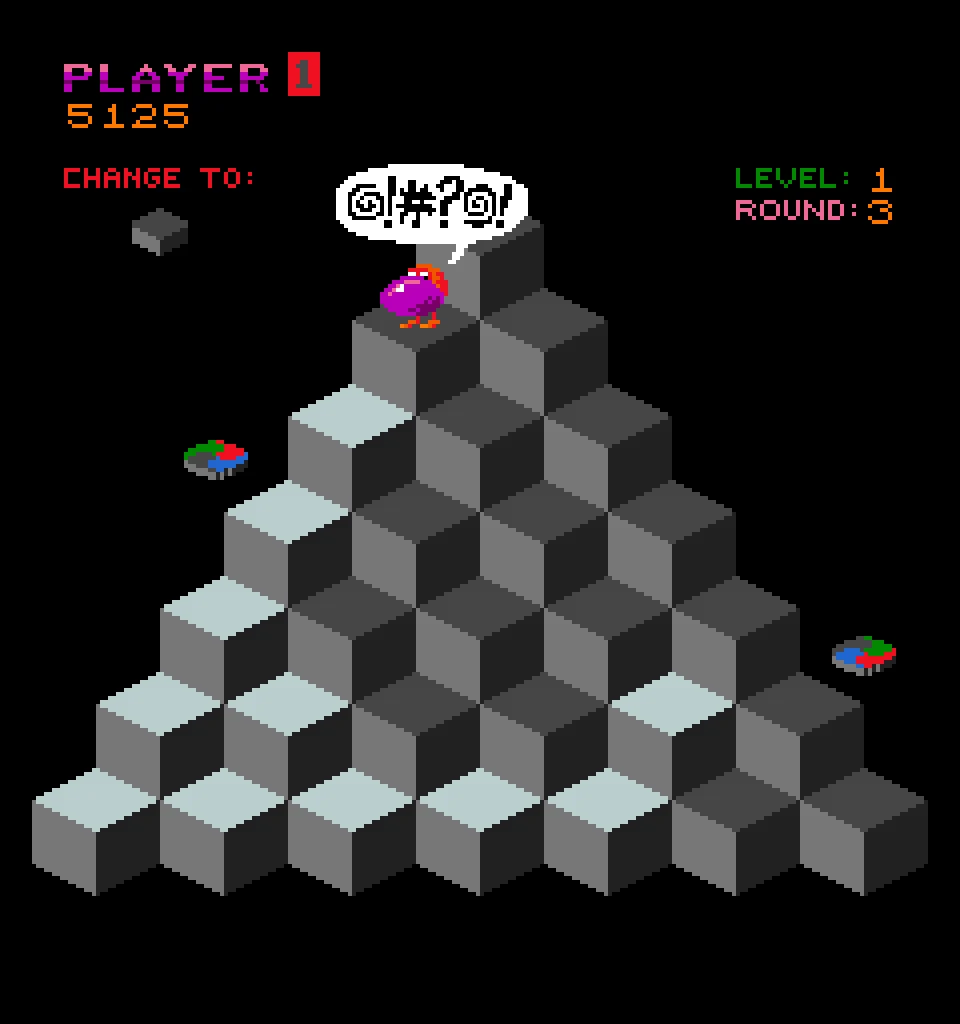 Q*bert, 1982. The @ is drawn as a spiral, which Mort Walker would have called a jarn.
The asterisk is a relative rather than a descendant. People were hiding letters behind stars in the eighteenth century, before any of the comics above, and f*ck is that tradition carrying on. It works differently from a grawlix, and the difference is the interesting part. Write f*ck and the reader fills in one letter. Write #@$% and the reader knows somebody swore and gets to choose the word. One is a redaction. The other is an invitation.
Then software started doing it, and the tradition went wrong. Some filters replace words automatically: tell one to change "ass" to "butt" and "classic" comes out as "clbuttic." Others block a word outright, which is how the residents of Scunthorpe found they couldn't sign up for AOL in 1996. We wrote that one up as the Scunthorpe problem. A grawlix drawn by hand is a joke you're in on. A filter that matches a string without understanding the word around it leaves you with a mistake you find out about later, if at all.
Television went its own way and replaced the word with a tone. That's a story of its own. And in 2017 the grawlix got its own emoji, 🤬, a face with symbols over its mouth, which means the thing a telegraph cartoonist drew in 1877 is now a single character on the phone in your pocket.
Where [@fuck.it] Lands
For about a hundred and fifty years a grawlix has let a cartoon character swear without spelling out the word. An @fuck.it address lets you do it before you've started writing the email.
If you're curious about the word in question, we've written about where it came from.
Sources & further reading: The Daily Cartoonist: That Gene Carr and his grawlix (the 1877 find) · Language Log: The birth of obscenicons (Ben Zimmer) · Language Log: Obscenicons a century ago · CBR: When were symbols first used to stand in for cursing in comics? · Todd Klein: Lettering terms and pioneers, part 3 · Vox (Phil Edwards): Why cartoon characters curse like this · Mort Walker, Backstage at the Strips (1975), excerpt · Mort Walker, The Lexicon of Comicana (1980) · Merriam-Webster: Grawlix · Lapham's Quarterly: A Star Is Born, on the asterisk (Claire Cock-Starkey) · Tobias Smollett, The Adventures of Peregrine Pickle (1751), Project Gutenberg · Australian Book Review: Blankety-blank, the art of the euphemism · Warren Davis: The Creation of Q*bert · Unicode: Face with Symbols on Mouth, Emoji 5.0 (2017)
Related reads: The (Bleep)ing History of Censor Tones · The Scunthorpe Problem: A Short History of Filters That Can't Read · The Fucking History of "Fuck" · The Village That Gave Up Fucking